Vol. 16 No. 2 (2023): Trilhas Filosóficas: Dossiê Gadamer
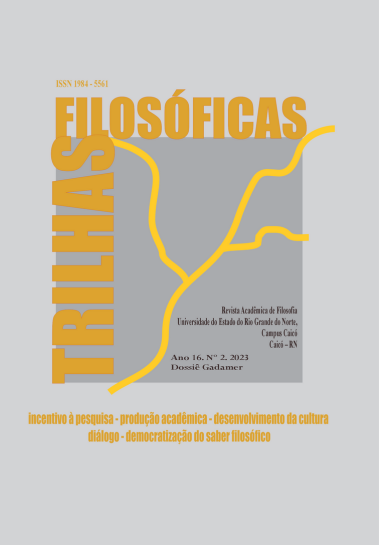
					View Vol. 16 No. 2 (2023): Trilhas Filosóficas: Dossiê Gadamer

Editor Convidado Prof. Dr Gustavo Silvano Batista (UFPI)

Published: 2024-11-06

EDITORIAL

DOSSIÊ GADAMER (v.16, n.2, 2023) 

  • Ciências humanas e suas raízes no conceito de "formação" (Bildung) em Verdade e método de H.-G. GADAMER

    Roberto Kahlmeyer-Mertens
    13-25
    DOI: https://doi.org/10.25244/tf.v16i2.5851
  • Diálogo e linguagem na hermenêutica filosófica

    Weksley Pinheiro Gama
    26-39
    DOI: https://doi.org/10.25244/tf.v16i2.6154
  • Linguagem, compreensão e mundanidade em Gadamer

    Tomás Jobin Coutinho Lopes, Ícaro Miguel Ibiapina Machado
    41-55
    DOI: https://doi.org/10.25244/tf.v16i2.5722
  • Linguagem e verbum na hermenêutica de H.G. Gadamer

    Francisco da Silva
    56-67
    DOI: https://doi.org/10.25244/tf.v16i2.5821
  • "Compreender de um modo diferente" Uma exigência ontológica da linguisticidade na hermenêutica de Hans-Georg Gadamer

    Rafael Lima Barros de Oliveira
    69-93
    DOI: https://doi.org/10.25244/tf.v16i2.6289
  • The notion of significant lived experience in Gadamer

    Vanessa Neubauer, Luiz Rohden
    95-108
    DOI: https://doi.org/10.25244/tf.v16i2.6198
  • Gadamer's hermeneutics as anti-hermeneutics: an invitation to free association with psychoanalysis

    Mauricio Martins Reis
    109-133
    DOI: https://doi.org/10.25244/tf.v16i2.5916
  • Gadamer and tolerance: between unusual virtue and human foundation

    Leonardo Marques Kussler, Guilherme Santos Guterres
    135-147
    DOI: https://doi.org/10.25244/tf.v16i2.5896
  • The ontological relevance of architecture on Gadamer’s thought

    Gustavo Silvano Batista
    149-157
    DOI: https://doi.org/10.25244/tf.v16i2.6355
  • Gadamer and women: feminist epistemology as a hermeneutical praxis

    Luciane Luisa Lindenmeyer
    159-171
    DOI: https://doi.org/10.25244/tf.v16i2.5808
  • Silja Freudenberger: an epistemological-political approach between Gadamer’s philosophy and feminist perspectives

    Luana Goulart
    173-193
    DOI: https://doi.org/10.25244/tf.v16i2.5925
  • Gadamer and Ricoeur: text, hermeneutics and reflexion

    josé Vanderlei Carneiro, Aluizio Oliveira de Souza
    195-213
    DOI: https://doi.org/10.25244/tf.v16i2.5818
  • [“Being (,) that can be understood (,) is language”: hermeneutical implications of the latinization of Gadamer's thought by Vattimo

    Jungley de Oliveira Torres Neto, Felipe de Queiroz Souto
    215-237
    DOI: https://doi.org/10.25244/tf.v16i2.5897

FLUXO CONTíNUO

  • What should education do in the face of the crisis?

    Harley Juliano Mantovani
    239-260
    DOI: https://doi.org/10.25244/tf.v16i2.6036
  • Philosophical reflections on racism and technology

    Juliele Maria Sievers, Luís Gustavo Guadalupe Silveira
    261-277
    DOI: https://doi.org/10.25244/tf.v16i2.6062
  • The concept of will: from the ancients to rousseau

    Marcos Saiande Casado
    279-294
    DOI: https://doi.org/10.25244/tf.v16i2.5628
  • Introductory observatiosn on the nature of self-consciousness in Kant

    José João Neves Barbosa Vicente, Ana Kelly Ferreira Souto Pinto
    295-311
    DOI: https://doi.org/10.25244/tf.v16i2.4225
  • The concept of tolerance amidst moral relativism: an essay against the absolutization of norms]

    Emerson De Medeiros
    313-326
    DOI: https://doi.org/10.25244/tf.v16i2.6200
  • Kierkegaard, irony, and nihilism: reflections based on the concept of irony

    Márcio Gimenes de Paula
    327-339
    DOI: https://doi.org/10.25244/tf.v16i2.6721
  • The history of philosophy as a thing of philosophy

    Marcos Aurélio Fernandes
    341-367
    DOI: https://doi.org/10.25244/tf.v16i2.6650